The Power and Control Wheel: Understanding Emotional Abuse In Intimate Relationships
What Is Emotional Abuse?
When people hear the word abuse, they often think of physical violence. However, abuse isn't always visible. Some of the most damaging relationship experiences involve emotional manipulation, intimidation, isolation, and behaviors designed to maintain power and control.
Emotional abuse can be particularly difficult to recognize because it doesn't always happen through obvious or dramatic incidents. Sometimes, it develops gradually through repeated interactions that leave you questioning your feelings, doubting your memories, or feeling responsible for someone else's behavior.
You might find yourself wondering:
Am I being too sensitive?
Why do I feel like I have to walk on eggshells?
Why am I constantly apologizing, even when I don't understand what I did wrong?
Why do I feel responsible for keeping everyone happy?
Is this normal relationship conflict, or is something else happening?
If you've ever asked yourself these questions, understanding the dynamics of emotional abuse may help you make sense of your experiences. Also, not every abusive relationship looks the same. Someone may experience some of these behaviors but not others.
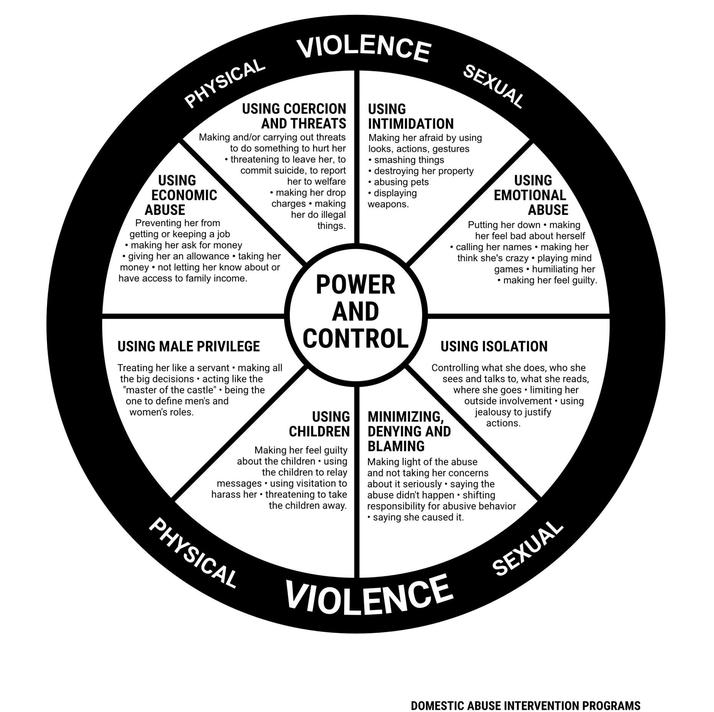
The wheel illustrates common tactics used to establish and maintain power and control in abusive relationships. Source: Domestic Abuse Intervention Programs.
The 8 Types of Power and Control
Coercion and Threats
Threatening to leave you “with nothing”, to physically abuse you, to embarrass you by “telling friends/family how you’re behaving”, threatening to harm themselves and “it would be all your fault”, to call the police and report you for abuse “and they’ll listen to me over you”. Sometimes they may carry out these threats and make them a reality. The objective is for you to discontinue your line of questioning, your reactions, your behaviors, your boundaries. Coercion can be used physically, emotionally, or sexually. Blame, guilt, and shame can be manipulated to make you feel as though you are being “too hard” on them or acting “unreasonable”.
Intimidation
Intimidation can overlap with coercion and threats, and both can be used to create fear and influence another person's behavior. Looks in public that let you know “you’ll pay for this later”, smashing/throwing things around or towards you. Using the physical environment to scare you; slamming doors/cabinets or driving erratically as you beg them to stop. Physically blocking you from leaving the environment, or breaking down doors/locks that are preventing them from getting to you. Meanwhile, you might hear “but I didn’t abuse you, I never laid a finger on you”.
Emotional Abuse
Making fun of you, embarrassing you, gaslighting, scaring you, and name calling, all under the guise “but it’s a joke”. This is the partner that will put your insecurities on display in front of others and laugh along so you’ll “lighten up”. It’s the partner that will continue to disregard emotional boundaries that you’ve placed. The one that will smash cake on your face at your wedding because “I thought it would be funny”, no matter how many times you asked them not to. They will tell you that “No one loves you but me. You have no family”. Then your hurt feelings are dismissed because “it was only a joke” or “you’re so sensitive”. Or they might gaslight and make you feel “crazy”, because “that never happened, what are you talking about?”
Isolation
This is an important part of the pattern for a person exhibiting abusive behaviors. Isolation gives them the freedom to continue the cycle, because “you know you have no one else”. They will guilt trip your time away with other people. They can feign jealousy over where you spend your time, even going as far as to accuse you of cheating. Every unsupervised moment becomes a fight. “I thought we were spending the weekend with my family”, “I don’t like those friends, they’re not good for you”, “your parents take you for granted, you’re so lucky to have my family to love you”. The larger the wedge that is created between you and your support system, the more you need to rely on your partner.
Minimizing, Denying, and Blaming
These behaviors go hand in hand with the emotional abuse mentioned above. If you’re being threatened, intimidated, emotionally/financially abused, isolated, or otherwise mistreated, these tactics will be the next step. Gaslighting, telling you “that never happened, I didn’t do/say that”, Minimizing, “it was only a joke, I was kidding, why are you so sensitive?”. Sometimes, what is commonly called "reactive abuse" can occur in these dynamics. I prefer the term "reactive defense" because calling a person's response "abuse" can obscure the context in which that reaction occurred. After prolonged intimidation, manipulation, or other forms of abuse, someone may respond in a way that is outside their usual behavior. They might scream, throw something, name call, or physically defend themselves. This doesn't automatically mean that every reaction is justified or harmless, but the context matters. A person engaging in abusive behavior may then use that reaction to shift attention away from the behavior that preceded it.
Using Children
This one is particularly painful and is sometimes a reason people experiencing abuse stay in the unhealthy pattern for a longer period of time. Putting children in the middle of the conflict “I wish we could go to the movie, but mommy would rather stay in bed and mope”, “Daddy doesn’t love us anymore”. Threatening to remove the children due to reactive defense or being emotionally unwell. It is important to point out that the abuse does not necessarily stop if the relationship ends. Post separation and post divorce abuse can occur, with the former partner using visitation rights and contact with the kids to manipulate and harass their ex.
Using Male Privilege*
This category refers specifically to using traditional gender roles and beliefs about male authority to establish or maintain power. In contemporary relationships, unequal expectations around household labor and the mental load can also become part of unhealthy power dynamics. One partner may consistently expect the other to manage household responsibilities while portraying themselves as incapable of completing basic tasks with phrases such as “where are my keys?”, “what time do we need to be at my mom’s for Christmas?”, or “oh, I needed this shirt washed for my meeting, I thought you’d take care of it”. Sometimes, weaponized incompetence can also play a part; they have used their “inability” to do certain tasks as a way to manipulate you into completing them, usually with a backhanded compliment about how you’re “better at it”. “Oh, you’re so much better at the dishes than I am, I’m not good at loading it, you always know exactly how to do it”. “I can’t be trusted with the laundry, I’ll mess it up, it’s better if you handle it so I don’t get in the way”.
Economic Abuse
This is another important part of the pattern, because it directly impacts a person’s ability to leave an abusive relationship. Interfering with your ability to work or make money. Giving you an “allowance” to spend on yourself while freely spending money on themselves. Putting the family into financial debt and needing you to “bail them out”. Removing your ability to use or access funds. Guilting you about purchases you make while overspending behind your back. Spending money on affair partners and asking you to cover the unknown bill. Accessing your account, moving money to an account you can’t access, or stealing individual funds so you are reliant on them. All while telling you “You can’t afford to leave me or live on your own”, “You’re lazy and don’t even work”, “Who’s going to financially support you if I’m not around?”
How Do I Know If I’m Experiencing Emotional Abuse in My Relationship?
One behavior by itself doesn't necessarily tell you whether a relationship is abusive. What can be more informative is looking at the pattern.
Ask yourself:
Do I feel afraid of my partner's reactions?
Do I change my behavior to prevent conflict?
Am I regularly blamed for someone else's behavior?
Do I feel increasingly isolated from friends or family?
Are my boundaries repeatedly ignored?
Do I frequently question my own memory or judgment?
Does my partner use money, children, threats, or other resources to influence my choices?
Do I feel as though I have to keep the peace to stay safe?
What If I Recognize My Relationship in the Power and Control Wheel?
Recognizing emotional abuse doesn't necessarily mean you have to make an immediate decision about your relationship.
Sometimes the first step is simply understanding what you're experiencing.
If the Power and Control Wheel resonates with your experience, you may want to explore some of the individual behaviors in greater depth, particularly gaslighting, isolation, emotional manipulation, boundary violations, and the cycle of abuse.
You don't have to figure it all out alone.
One of the things I often help clients explore is the difference between taking responsibility for their own behavior and taking responsibility for someone else's. If you're struggling to understand what is happening in your relationship, therapy can provide a space to explore those patterns, develop healthier boundaries, and rebuild trust in yourself. Relationship Recovery offers virtual therapy throughout Florida for individuals navigating difficult relationships, emotional abuse, boundary challenges, and narcissistic abuse.
Outside of therapy, utilize the resources below if you need additional help.
If you or someone you know is affected by domestic abuse, confidential help is available 24/7:
Emergency: Call 911 if you are in immediate physical danger.
National Domestic Violence Hotline: Call 1-800-799-SAFE (7233) or text START to 88788.
Florida Domestic Violence Hotline: Call 1-800-500-1119 for state-specific assistance and resources.
* This author acknowledges that abuse can occur across genders, sexual orientations, racial and ethnic groups, socioeconomic backgrounds, religions, and relationship structures.
